What Are Some Examples of Abilities to Dissolve in Water and to Conduct Electric Current Art
In this class practical, students examination the conductivity of covalent and ionic substances in solid and molten states
This experiment enables students to distinguish between electrolytes and not-electrolytes, and to verify that covalent substances never behave electricity fifty-fifty when liquefied, whereas ionic compounds carry when molten.
The practical works well as a course experiment, with students working in groups of 2 to 3. There volition not be time to investigate all the substances, and so each grouping could be assigned three or iv of these, and the results pooled at the terminate.
Equipment
Apparatus
- Eye protection
- Carbon (graphite) electrodes, fitted in a holder (see note 1 beneath)
- Bunsen burner
- Tripod
- Pipeclay triangle
- Rut resistant mat
- Clench and stand up
- Small pieces of emery paper
- Connecting leads and crocodile clips
- DC power pack, six V
- Calorie-free bulb in holder, 6 Five (see note ii below)
Apparatus notes
- The carbon electrodes demand to be stock-still in some sort of support – such as a polythene holder or large rubber bung – so that in that location is no possibility of the electrodes beingness allowed to short-circuit. The electrodes need to be fixed in such a way as to fit inside the crucible supplied.
- A light seedling has more visual bear on, simply an ammeter can be used instead.
Chemicals
- Small pieces of pb (TOXIC), copper and perhaps other metals
- Crucibles containing samples of:
- Phenylsalicylate (salol) (IRRITANT, Dangerous FOR THE Surround)
- Polythene
- Wax
- Saccharide
- Zinc chloride (CORROSIVE, Unsafe FOR THE Surroundings)
- Potassium iodide
- Sulfur (optional)
Health, safety and technical notes
- Read our standard health and rubber guidance.
- Wear center protection throughout.
- Pb, Atomic number 82(s), (TOXIC) – run across CLEAPSS Hazcard HC056.
- Copper, Cu(due south) – see CLEAPSS Hazcard HC026.
- Phenylsalicylate (salol), Cvi H4 (OH)COOC6 H5 (s), (IRRITANT, DANGROUS FOR THE ENVIRONMENT) – run into CLEAPSS Hazcard HC052.
- Wax – run into CLEAPSS Hazcard HC045b.
- Sugar (sucrose), C12 H22 O11 (s) – meet CLEAPSS Hazcard HC040c.
- Zinc chloride, ZnClii (s) (CORROSIVE, Dangerous FOR THE ENVIRONMENT) – come across CLEAPSS Hazcard HC108a.
- Potassium iodide, KI(s) - run into CLEAPSS Hazcard HC047b.
- Sulfur, Due south8 (s) – see CLEAPSS Hazcard HC096A. Sulfur is a not-metallic element and is a good substance to have included in the listing. Only at that place is a strong likelihood of it catching burn down, with sulfur dioxide, SO2 (g), (TOXIC), given off. Sulfur fires are hard to extinguish. If information technology happens, cover the vessel with a clammy cloth and leave in place until absurd. If there is time, sulfur can be washed as a teacher demonstration. Heat a small sample of 'flowers of sulfur' very, very slowly. Sulfur is a very poor conductor of heat, and localised heating is likely to cause it to commencement burning! Y'all must utilize a fume closet.
Process
Part one
- Set upward the circuit as shown in the diagram, at this stage do not include the crucible or bunsen burner flame (these are for later).
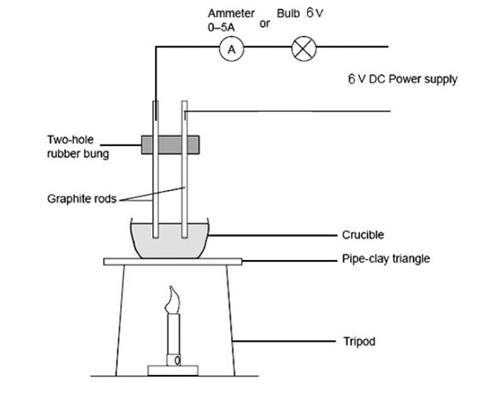
- Select i of the metals, and by holding the electrodes in contact with it, detect out whether or non it conducts electricity and so switch the current off.
- Note downwards the results using the educatee canvass bachelor with this resource (see download links below) and repeat this experiment with each metal available.
- Select one of the solids contained in a crucible. Lower the electrodes then that they are well immersed in the solid, and and so clench the electrodes in position.
- Switch on the electric current and find out whether the solid conducts electricity or not, then switch the current off once again.
- Set the crucible over a Bunsen burner on a pipeclay triangle and tripod, and clamp the electrodes in position over the crucible. Gently heat the sample until it but melts, and then plow off the Bunsen flame. If necessary lower the electrodes into the molten substance, before clamping them once more.
- Switch on the current again. Does the molten substance bear electricity now? Switch the current off again.
- Write up all your observations.
- Enhance the electrodes from the crucible, and allow them to cool.
- Make clean the electrodes with emery paper.
Part ii
Repeat steps 4 to 10 with some or all of the other solids.
Part 3
Pool your results with other groups then that your table is complete.
Teaching notes
The covalent solids only need to exist heated for a short fourth dimension for melting to take identify. Nether no circumstances should heating be prolonged, otherwise the substances may decompose and/or burn. The students should exist warned about what to practice if this happens eg cover with a damp cloth. The experiments should be done in a well-ventilated laboratory.
Information technology may be helpful to reserve a crucible for each of the powdered compounds, while having one or two others that tin can be heated. Once a solid has been liquefied and allowed to cool, the solidified lump is ofttimes hard to break up or powder in the crucible.
Zinc chloride melts at almost 285 °C, so heating needs to be fairly prolonged in comparison with the covalent solids. Information technology will, notwithstanding, produce chlorine (TOXIC) so heating should end as shortly as conductivity is detected. Potassium iodide melts at about 675 °C, so very potent and prolonged heating is needed here.
Student questions
- What do y'all conclude virtually the electric conductivity of metals?
- Do all of the solid compounds comport electricity?
- Do whatever of the molten compounds conduct electricity. If then, which ones?
- Why practise some substances bear only when they have been liquefied?
- Tin can you at present classify all the compounds equally existence either ionic or covalent?
Answers
- All the metals conduct electricity well. You should explain this electrical conductivity in terms of the 'free' electrons inside a metallic construction.
- No, none of them.
- Yep, zinc chloride and potassium iodide.
- Some substances are ionic, merely electric conduction is only possible when the ions are gratis and mobile. This happens once the solid has been melted.
- Phenylsalicylate, polythene, wax and carbohydrate are covalent. Zinc chloride and potassium iodide are ionic.
Additional information
This is a resources from the Practical Chemical science projection, developed past the Nuffield Foundation and the Royal Social club of Chemistry. This collection of over 200 applied activities demonstrates a broad range of chemic concepts and processes. Each activity contains comprehensive data for teachers and technicians, including full technical notes and step-by-pace procedures. Applied Chemical science activities accompany Practical Physics and Practical Biology.
© Nuffield Foundation and the Royal Society of Chemistry
Health and safety checked, 2016
Source: https://edu.rsc.org/experiments/which-substances-conduct-electricity/1789.article
0 Response to "What Are Some Examples of Abilities to Dissolve in Water and to Conduct Electric Current Art"
Post a Comment